1. Home
  2. Work & Contributions

Six lines of work,
examined

What a state party president actually does, set out case by case: the context each piece of work sits in, what it was for, what was undertaken, and what can and cannot be said about its result.

How to read this page

Organisational work is measured in structures, not outcomes

A state president does not pass laws or hold a portfolio. The work is building and maintaining an organisation, and setting the unit’s public position. Where the record shows a completed structure — a tour finished, a drive concluded, a training programme delivered — that is stated. Where a matter remains open, such as the Naga political issue or the Frontier Nagaland Territory demand, the position taken is reported without any claim about its resolution.

01

Organisation

Rebuilding the unit from the booth upward

Context. The BJP contests Nagaland as a coalition partner in a state of sixty assembly constituencies, with a demanding geography: mountainous eastern districts, poor connectivity, and a political culture organised around villages and tribal bodies rather than around party branches. An organisation that exists only in Kohima and Dimapur cannot function there.

Objective. To give the unit a physical presence in every district, and then a formal structure — a committee — at the level of the individual polling booth.

What was undertaken. Yepthomi spent his first year as president touring rather than administering. By the completion of that year on 25 September 2024 he had visited every district in Nagaland, covering thirty assembly constituencies and all twenty constituencies of Eastern Nagaland, together with twenty mandals in the eastern region. In July 2024 the extended state executive meeting at IMC Hall, Dimapur, resolved to form booth-level committees across all polling booths in the state ahead of its next meeting at Tuensang in November 2024, with a further meeting set for Noklak in April 2025.

What can be said of the result. Regional reporting described him as the first state BJP president to have toured and connected with the grassroots this extensively during a first year in office. The tour itself is documented; the completion rate of the booth-committee programme is not established in published reporting, and is not claimed here.

  • PeriodSeptember 2023 – September 2024
  • ReachAll districts of Nagaland; 30 assembly constituencies
  • Eastern regionAll 20 constituencies; 20 mandals
  • Structural aimA committee at every polling booth
  • Adopted atExtended State Executive Meeting, IMC Hall, Dimapur, 16 July 2024
02

Membership

Sadasyata Abhiyan: counting the party

Context. The BJP runs a national membership cycle in which every state unit enrols members for a fixed period. For a unit like Nagaland’s, the drive is not only a count — it is the mechanism by which the organisation discovers where it actually exists.

Objective. To raise enrolment above the unit’s previous figure and, in doing so, to extend the organisational structure into places where the party had little formal presence.

What was undertaken. A state-level workshop was held at Dimapur on 21 August 2024, attended by Yepthomi with Lok Sabha MP Kamakhya Prasad Tasa, PHED Minister Jacob Zhimomi and Deputy Chief Minister Y. Patton. Yepthomi then led a State Presidential Mandal Tour from 4 September to 24 September 2024, opening at Tizit in the far north-east of the state and concluding at Seyochung–Sitimi. The drive ran across roughly 140 locations statewide, more than nine of them in Dimapur alone.

What can be said of the result. Yepthomi stated that the party had around 2.15 lakh active and primary members in Nagaland, enrolled against a previous figure of about two lakh, with membership valid for the 2024–2030 cycle. Two political entries into the party occurred during the tour: Sethrichem Sangtam, a former RPI candidate and founder of the Better Life Foundation Nagaland, joined with supporters at Longkhim–Chare on 12 September; and Yangseo Sangtam, former Deputy Speaker of the 13th Nagaland Legislative Assembly, merged into the party with supporters at Kiphire town on 23 September.

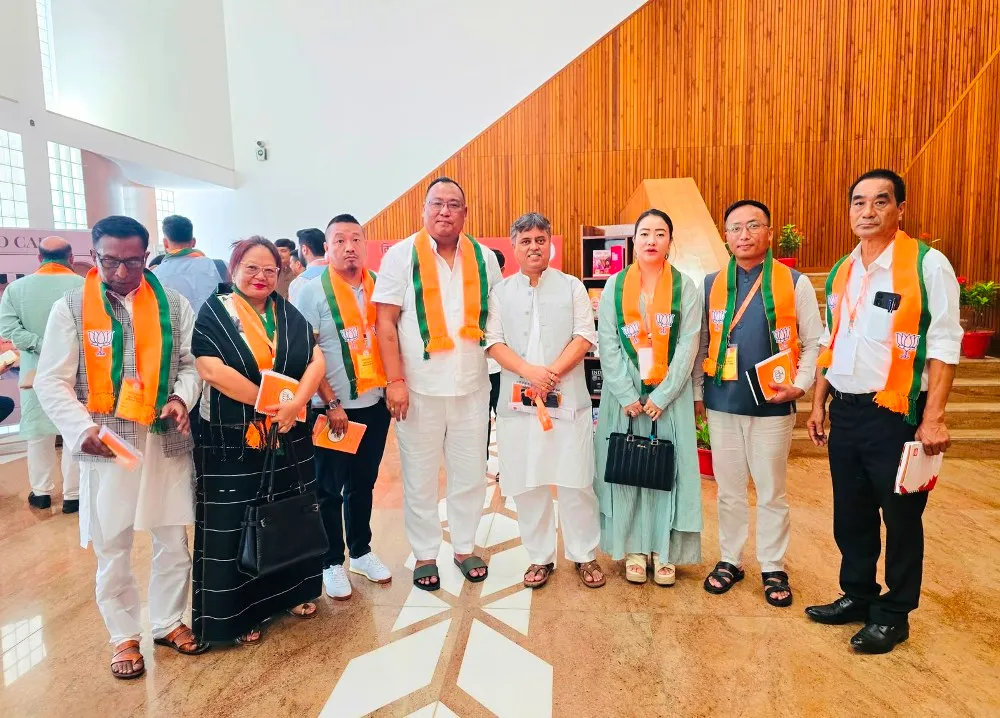
Benjamin Yepthomi standing with seven other BJP Nagaland leaders wearing party scarves at a national-level party meeting venue.
Figure 01Benjamin Yepthomi with the BJP Nagaland state team at a national-level party meeting.
03

Eastern Nagaland

The Frontier Nagaland Territory demand

Context. The Eastern Nagaland People’s Organisation represents the tribes of the state’s eastern districts, historically the least served by infrastructure, administration and development spending. Its demand for a separate Frontier Nagaland Territory has become the most consequential internal political question in Nagaland, and it runs directly through the assembly constituencies where the BJP has been trying to build.

Position taken. At a press conference in Dimapur on 26 August 2024, Yepthomi said: “The concerns of our Eastern brothers and sisters are deep rooted, genuine and legitimate,” and “their long-standing issue deserves a quick resolution.” He said the party stood with the people of the ENPO, described the demand as affecting all Naga people, and expressed confidence that the Prime Minister and Home Minister Amit Shah intended an amicable settlement. He argued that only a BJP-led coalition could resolve the matter.

Organisational counterpart. The position is matched by organisational effort in the same region: the twenty eastern assembly constituencies were covered in his first-year tour, and the 2024 membership drive opened at Tizit in the far north-east.

Status. The demand remains an open negotiation between the Government of India, the state government and the ENPO. No claim of resolution is made here.

“The concerns of our Eastern brothers and sisters are deep rooted, genuine and legitimate.”

Press conference, Dimapur, 26 August 2024
04

The Naga political issue

Supporting a settlement, from the unit’s side

Context. The Naga political issue — the decades-long negotiation between the Government of India and Naga political groups — is the defining question of Nagaland’s public life, and no state party unit can avoid holding a position on it.

Position taken. Under Yepthomi’s presidency the unit has supported an early, inclusive and honourable solution, and has formally appealed to the Government of India and the negotiating parties to expedite the finalisation of the process. That position was adopted as a resolution at the extended state executive meeting at Dimapur in July 2024.

Yepthomi has expressed appreciation for the Naga political groups engaged in peace talks with the Government of India, and for those that entered the peace process in response to public opinion, as a way of clearing the path to a final settlement.

Status. The negotiation is unresolved. What is documented is the unit’s stated position and its appeal for expedition — not an outcome.

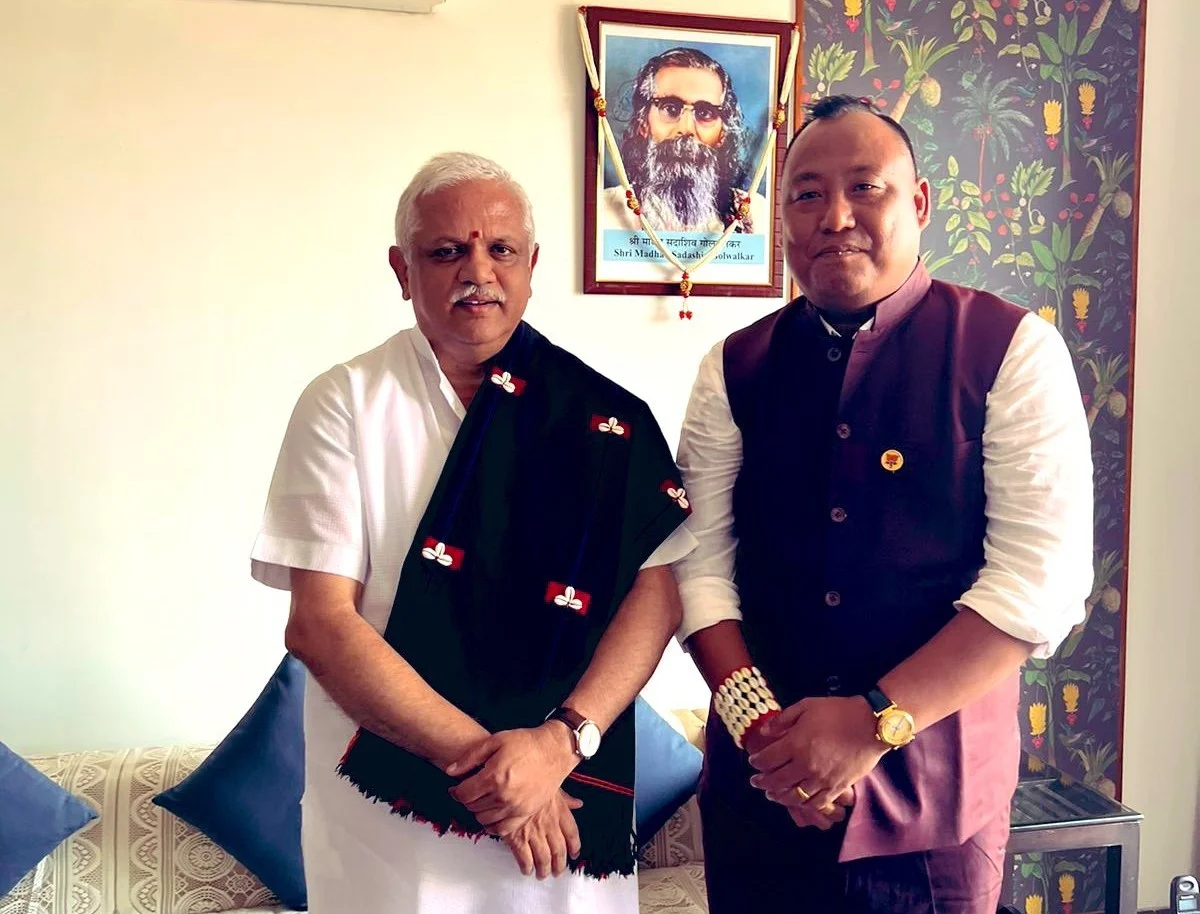
Benjamin Yepthomi standing beside a senior national party leader wearing a Naga shawl, at an indoor meeting.
Figure 02Benjamin Yepthomi calls on the party’s central leadership, a Naga shawl presented in greeting.
05

Cadre training

Political education in the eastern districts

Context. A membership drive produces names. Turning names into a functioning cadre requires training — in ideology, in the mechanics of booth management, and increasingly in how central welfare schemes reach the people entitled to them.

What was undertaken. On 9 May 2026 Yepthomi addressed the Pandit Deendayal Upadhyaya Prashikshan Mahabhiyan–2026 at Longchang village, Aboi — a two-day district-level training programme covering the Mon, Longleng and Aboi districts. Sessions covered BJP ideology, organisational expansion, booth management, social media outreach and the implementation of Modi government welfare schemes.

The argument made. Yepthomi said several welfare schemes launched under the Prime Minister had benefited the poor, but that a lack of awareness had deprived many eligible beneficiaries — framing cadre training as a delivery problem rather than only a political one. He pointed to the region’s potential in tourism and agriculture, and urged voters to reject electoral inducements.

Significance. The programme was held in the same eastern districts covered by the first-year tour and the membership drive — a third pass through the same territory, with a different instrument.

  • ProgrammePandit Deendayal Upadhyaya Prashikshan Mahabhiyan–2026
  • Date9 May 2026, over two days
  • VenueLongchang village, Aboi
  • Districts coveredMon, Longleng and Aboi
  • CurriculumParty ideology; organisational expansion; booth management; social media outreach; welfare-scheme implementation
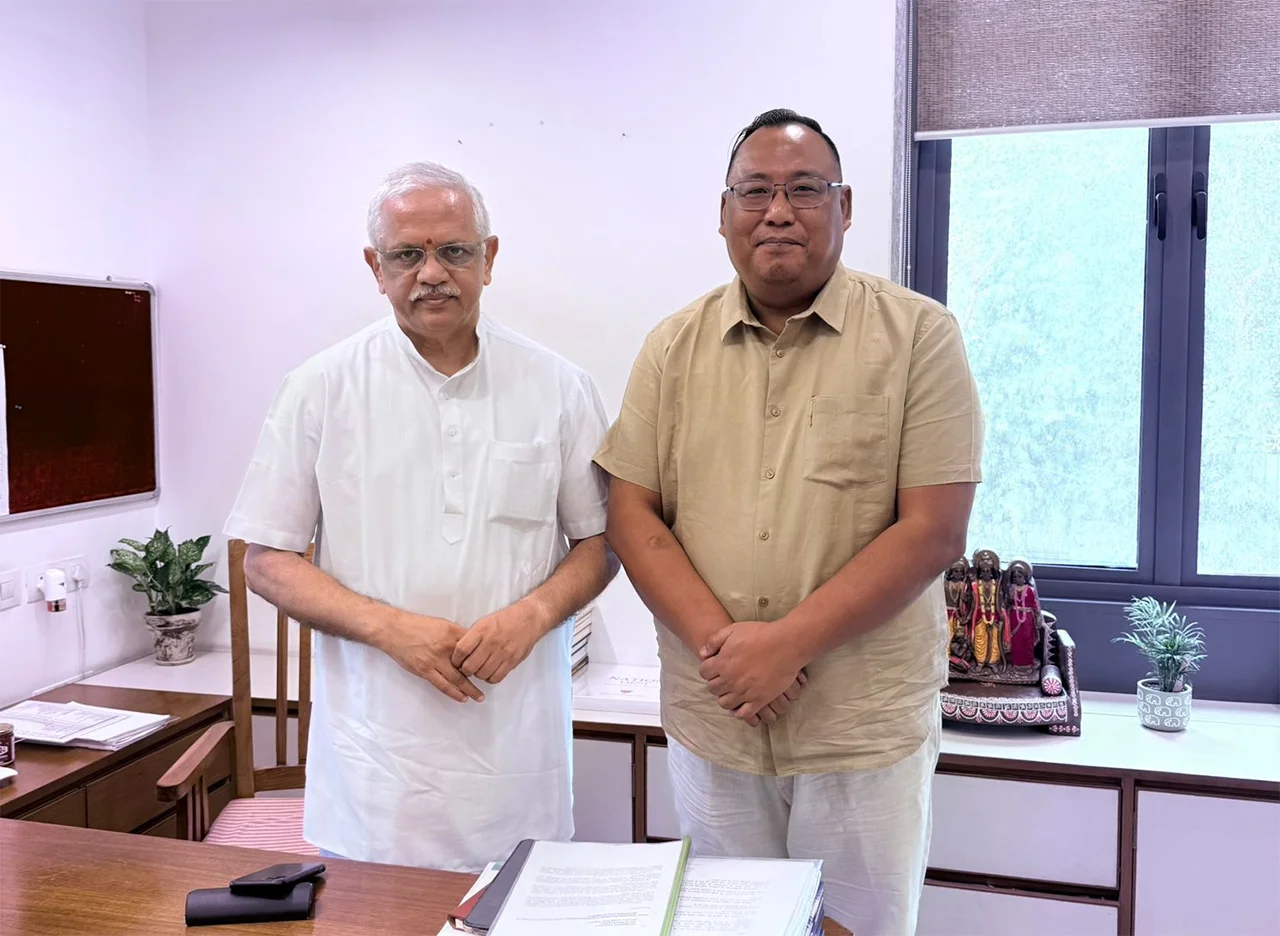
Benjamin Yepthomi standing with BJP National General Secretary (Organisation) B. L. Santhosh in an office at the party headquarters in New Delhi.
Figure 03With B. L. Santhosh, National General Secretary (Organisation), at the party headquarters, New Delhi, July 2026.
06

Delhi and the region

Carrying the state’s case to the centre

Context. For a small north-eastern state, the relationship between the state unit and the national organisation is not ceremonial. Cadre development, expansion planning and the flow of central attention to the region all run through it.

What was undertaken. On 6 July 2026, Yepthomi called on BJP National General Secretary (Organisation) B. L. Santhosh at the party headquarters in New Delhi. The two discussed organisational strengthening, cadre development and the party’s expansion roadmap in Nagaland. Yepthomi described Santhosh as a leader known for “simplicity, humility, warmth and accessibility,” whose patience in listening to party workers had earned him respect among karyakartas across the country, and as “a fatherly figure whose guidance continues to inspire party workers to serve the organisation with greater dedication.”

The wider argument. Responding to the Union Budget 2026–27 on 23 July 2026, Yepthomi called it “futuristic and people-centric” and among the most comprehensive and inclusive budgets to date. He said Nagaland would benefit through infrastructure, connectivity, tourism promotion and employment generation, and that the state would continue to receive central grants and tax devolution. He cited the rise in the Ministry of Development of North Eastern Region allocation from ₹5,915 crore in 2025–26 to ₹6,812.30 crore in 2026–27 as a demonstration of commitment to the region.

“India cannot truly develop unless the Northeast develops.”

On the Union Budget 2026–27, 23 July 2026

In summary

What the record shows

  • 3 weeksDuration of the 2024 State Presidential Mandal Tour, Tizit to Seyochung–Sitimi
  • ~140Locations at which the 2024 membership drive was conducted statewide
  • 2024–2030Validity period of the memberships enrolled in that drive
  • 3Eastern districts covered by the 2026 cadre training programme